
Outcomes Magazine
Talking Leadership
Building Flourishing Teams
By Christian Leadership Alliance
Back to listing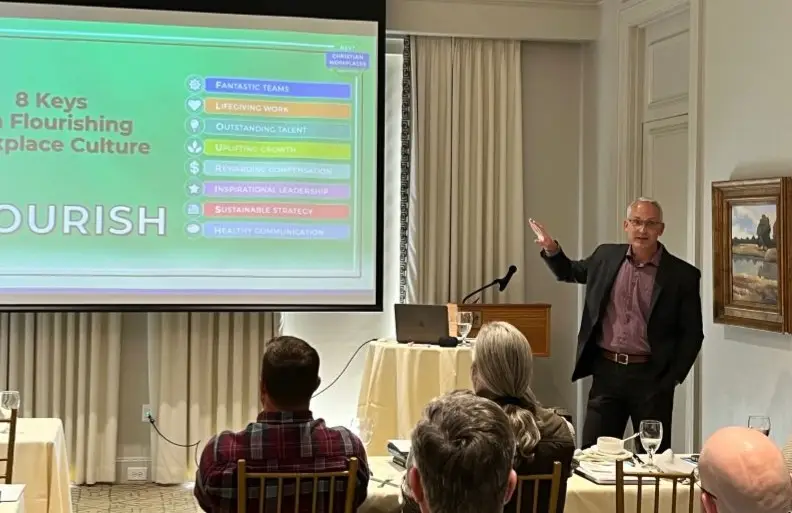
Best Christian Workplaces’ Jay Bransford shares wisdom
Christian Leadership Alliance President and CEO Tami Heim, recently interviewed Jay Bransford, President and CEO of Best Christian Workplaces.
This edition of Outcomes explores equipping teams for success. Best Christian Workplaces believes kingdom impact hinges on the well-being of your people and the health of the workplace culture you create. They offer a well-researched Christian-based employee engagement survey designed to help uncover blind spots and build a Flourishing Workplace™ culture.
Jay is passionate about maximizing performance and effectiveness of Christian leaders, teams, and organizations to accomplish God’s purposes. He is driven by Jesus’ prayer in John 17 for believers to be united to make God known to others. He believes Christian-led workplaces should set the standard as the best, most effective places to work in the world.
Jay has 30 years of experience as an organizational consultant, helping companies manage and accomplish large-scale change initiatives. He has coached many leaders and is an expert on influencing human performance, change management, strategic planning, and team and leadership development. Jay has provided consulting services for companies such as FedEx, American Express, Cracker Barrel Old Country Store, Sprint, Accenture, Fujitsu Consulting, Qwest, and several state governments.
In 2005, Jay began his 16-year service to churches, mission organizations, and Christian nonprofits as a missionary in Asia. He served as the leader to 120+ staff and 20 ministries serving in Northern Thailand. Jay also launched and served as the Chairman of the Asia Leaders Learning Community, creating resources to develop and equip the next generation of thousands of Christian leaders across Asia. He has co-authored and published two leadership books.

From your vantage point at Best Christian Workplaces what’s working on team well-being for Christian ministries today and where is there need for improvement?
I’ll start by saying that it is so encouraging to see more and more Christian leaders recognizing the importance of workplace culture and the well-being of their staff. It matters to God according to 1 Peter 5:2 which says, “be shepherds of God’s flock that is under your care.” And it matters for the accomplishment of an organization’s mission. Research shows that flourishing, engaged employees are 33% more productive than those who are unengaged.
Earlier this year Best Christian Workplaces (BCW) published our annual State of the Christian Workplace report, highlighting our research findings for 2025. The good news is that across 441 organizations 61% of surveyed employees reported being engaged in their roles. But that obviously leaves another 39% of people who are not working in an atmosphere that encourages them to bring their best self to work each day – maximizing their energy, enthusiasm, commitment and passion.
Where have we seen organizations making improvements?
Where have we seen organizations making improvements? Well, over the past year in the parachurch sector, for example, we not only saw a perceived improvement with employee health plans and compensation, but the data also showed that many aspects of healthy communication improved such as involving staff in decisions that affect them.
The data also showed that parachurch organizations tended to struggle slightly more this past year with the topic of diversity, providing job security, and staff feeling that leaders demonstrate compassion for people at all levels of the organization.
It’s important to remember, though, that every organization has its own unique strengths and weaknesses as it relates to culture and the well-being of their staff.
How does equipping team members well support their growth and job satisfaction?
BCW research consistently shows that when team members are well-equipped, they feel valued, capable, and growing. This leads to greater confidence, trust in leadership, and a deeper sense of purpose in their work. Those are all key drivers of both employee engagement and flourishing workplace cultures.
In addition, it can be helpful to remember that God calls people to meaningful work and growth (see Col. 3:23, Eph. 4:12).
Therefore, when employees are developed and equipped, they experience their work not just as a job, but as part of their calling and contribution to God’s purposes. It’s hard to imagine a driver for job satisfaction that would be more significant than truly knowing that you are called and equipped for meaningful, kingdom work.
How can we equip team members to be resilient in today’s fast-changing world?
Resilience can be defined as “the ability to adapt well to adversity or change.” So, it’s no surprise that our fast-paced and changing world often requires high levels of resilience from people. Those who are most resilient tend to have a positive mindset, high commitment to a purpose or goal, and strong relational support from others. And the good news is that resilience isn’t just a genetic strength or trait unique to an individual, it’s something that workplaces can and should intentionally cultivate in their workplace culture.
Healthy organizations equip their team members to be resilient…
Healthy organizations equip their team members to be resilient by providing role clarity, building caring and supportive relationships, providing opportunities to learn and grow, creating strong two-way communication channels in and across teams and across levels of leadership, constantly reinforcing the organization’s purpose and impact, and anchoring all that they do in their faith. This allows people to navigate change with confidence, endurance, and hope.
What are some ways you have equipped your team at Best Christian Workplaces?
Every year BCW asks for feedback from our staff through our own employee engagement survey. And every year we learn something new and act on their feedback. Getting input from our staff helps us better respond to the never-ending changes in the world around us that impact both our organization and the needs of our staff. One thing we learn from our survey each year is about the kinds of ongoing training and development that our staff feel they need to be successful in their roles.
Over the past couple of years, we have responded by providing staff training in several key areas: conflict competence, defining and valuing diversity, developing our innovation and creativity, and building skills to better utilize AI. We have used training courses from LinkedIn Learning, and we have utilized our own BCW consultants to lead workshops and discussions on those topics.
We commonly reflect on our learnings and application of our learnings in our Teams channels, in our regular one-on-one meetings with staff, and in our monthly all-hands meetings. The post-training reflection process helps us to better remember, share, and incorporate our learnings into our everyday lives.
Thankfully, I can say that as a result of our ongoing staff development efforts, we have noticed both individually and collectively a marked improvement in our approach to conflict, our clarity around our value of diversity, and the level to which we are embracing innovation. Recently, I have really enjoyed reading testimonials from our staff in our Teams channel about their “ah-ha” moments using AI and how it gave them incredibly helpful results and saved them significant amounts of time.
What is the top way you encourage leaders to unlock their team’s potential?
If I was to select the one most powerful way to unlock the potential of people and teams, it would be to develop leaders, managers and supervisors who truly invest in their people—leaders who know them, listen to them, coach them, build trust, provide clarity, and connect their work to a greater purpose. When leaders lead this way, people don’t just perform—they grow and flourish.
Leaders can better know their people by learning about each person’s strengths, motivations, and aspirations.
Leaders can better know their people by learning about each person’s strengths, motivations, and aspirations. This requires leaders to take time for regular, meaningful one-on-one conversations. It’s important to not just think of people in terms of their role, but for their God-given potential. People grow fastest when they feel known, understood and valued, not managed at a distance.
Leaders can also unlock people’s potential by coaching them. In this case, I’m using Kenneth Blanchard’s definition of “coaching” from his Situational Leadership model.
This kind of coaching can be in the form of providing feedback and encouragement. But it often looks more like asking questions rather than “telling” people things. So, it’s no surprise that I love the wise quote from Peter Drucker saying, “The leader of the past knew how to tell, the leader of the future will know how to ask.”
Leaders unlock people’s potential by building trust and safety. BCW’s research consistently highlights trust as foundational to a healthy culture. Leaders must listen well and act with integrity. Staff and teams need to feel that they are safe to speak up, try new things, and even fail. And staff grow in their trust when they see consistency between the words and actions of their leaders.
Aligning Purpose and Calling
In addition, leaders unlock the potential of their staff and teams by reinforcing and aligning purpose and calling. They must continually connect people’s work activities to the overall mission, vision and impact of the organization.
Effective leaders affirm how each person’s role uniquely contributes to the organization and to kingdom impact. They help individuals see their work as a calling, not just as a job. At BCW we know that “purpose” can provide staff with a significant sense of life-giving work which is a multiplier of effort, energy, and commitment.
Lastly, for people looking for a helpful resource on how to unlock the full potential of your people and teams, I highly recommend reading the book Road to Flourishing: Eight Keys to Boost Employee Engagement and Well-Being (IVP, 2022) written by BCW’s co-founder, Al Lopus.
###
Want to learn more? Visit workplaces.org.

Table of Contents
- From your vantage point at Best Christian Workplaces what’s working on team well-being for Christian ministries today and where is there need for improvement?
- How does equipping team members well support their growth and job satisfaction?
- How can we equip team members to be resilient in today's fast-changing world?
- What are some ways you have equipped your team at Best Christian Workplaces?
- What is the top way you encourage leaders to unlock their team's potential?
- Aligning Purpose and Calling
Featured Articles

A Story from the Heart
Aug 27, 2026

Storytelling That Endures
Aug 27, 2026

Structuring Successful Storytelling
Aug 27, 2026
